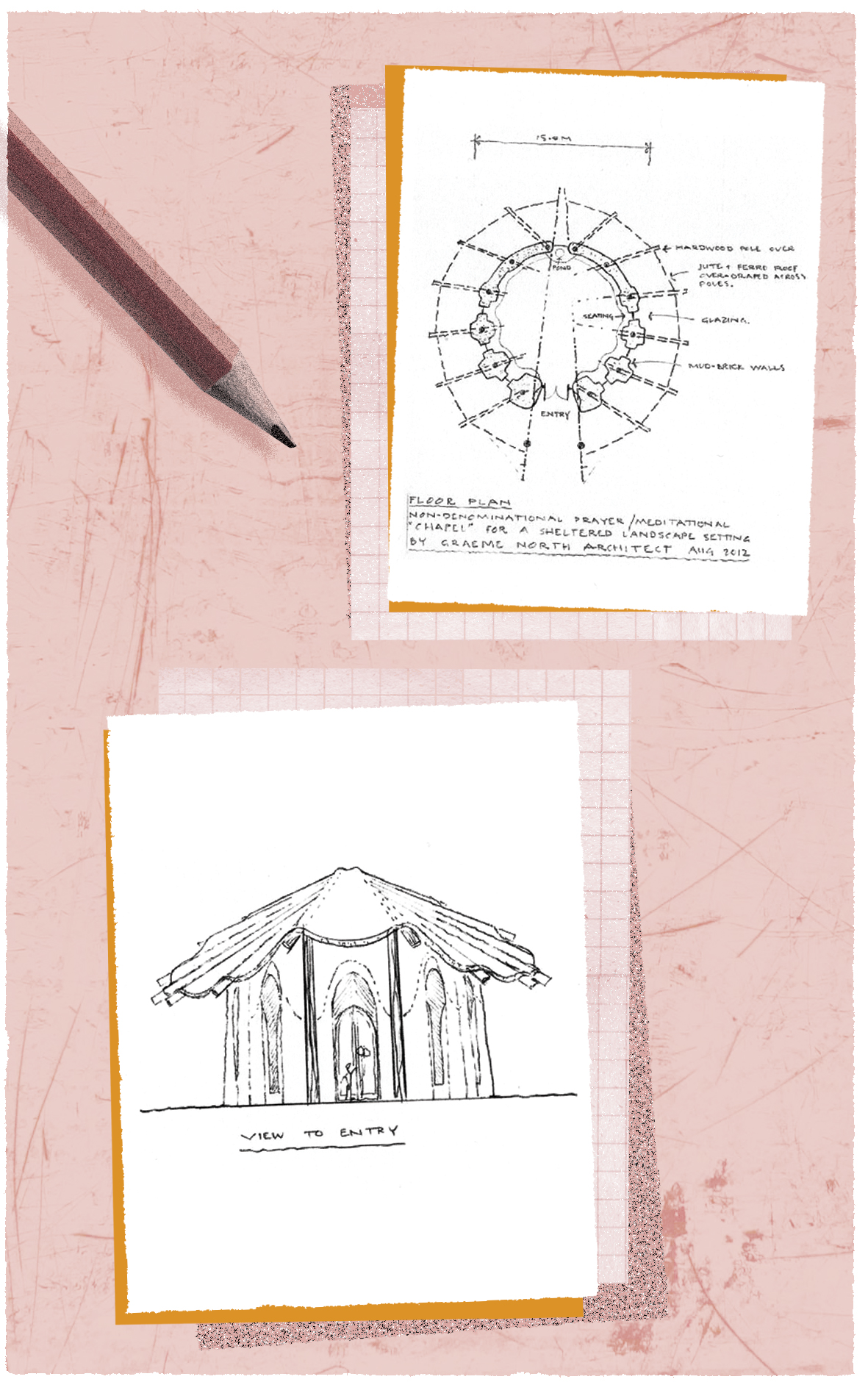
The afternoon we were waiting for the doctor to call with the results, my father, an architect, asked me to sluice clay from the duck pond on the front of his property.
The one fringed with poplar trees, their winter-ruined branches skeletons guarding the murky brown water.
He didn’t look up as he spoke. He was urgent for the first time in weeks. Bent over his drawing board, his greying seabird’s-nest curls – the ones his mother loved, a halo – flecked the gold of his youth again in the slanting late afternoon light. His roll of translucent paper was stretched over the top of his plan, tacked down at the edges with masking tape. Between his fingers was his pencil stub – the only pencil I’ve ever seen him use, 4B, never quite sharp. He was carving with it now – soft, scooping circles. Beside him a jar of black and red pencil stubs, some used down to the bone.
He was standing, slippered feet planted on the bare wooden floor, chair pushed back, bent sideways over his drawing board, the ruler pushed askew, unnecessary. He hadn’t stood like that for what felt like weeks, either.
When he asked me to dig the clay he knew two things: the pond was inside the fenced-in duck run and I had a fear of ducks (really, even as a grown adult the panic-beaty-heart starts when they get too close); and also, I hate touching clay.
It must be soft, wet. I would know what to do, he said.
And he was right. Despite not wanting to know how to prepare clay, despite wilfully ignoring his patient teachings over the years, I did know how to scoop clay from the soft edges of the pond, wet and whisk it in a bucket, soften it till it was the right consistency to work into shape.
Before I said yes to the clay – we both knew I would – I asked him why. His pencil paused mid-swoop, hovered for a moment in the air towards me, like he might tell me then, but instead just waved me away. I put his gumboots on, far too big for me but waiting as always at the door, then went into the cold.
Later, when he wasn’t in his office, I snuck a peek at his plans, running my fingers lightly over the thick pencil lines. A circular earth building, of course. It was so clearly one of his – I would have known that anywhere – but this didn’t look like the houses he usually designed. It looked vaster, and it was open, just one large curving room winged in windows with a high, open door.
“What is it, Dad?” I said when he came back, caught me looking.
He took the bucket of clay. “A place of worship. A chapel.”
“Really?”
“Yes.” He sat down, dipping his hands into the bucket.
“You’re not –”
“This isn’t about that. This doesn’t align to any religion.”
“Chapels like that don’t exist, Dad.”
He came up with a lump of clay. Whacked it down onto the drawing board, winked. “Nothing ever does until it’s built.”
Quiet, standing to the side of his workbench, out of his light,
I watched him work up handfuls of the clay I’d collected, the way I used to as a child, sneaking out to the shed tacked on to the side of our house, his ‘office’, the one he’d built on to our converted bach by the sea, fitting it with barn doors he’d ferreted from somewhere, once used to keep the horses in, or, in his case, keep us kids out – we couldn’t open the high, heavy door on our own.
I was just tall enough to peer over the top of the bottom door, see him leaning into his drawing board, a pencil dangling from his mouth like a forgotten cigarette, or if he wasn’t there, sitting back in the shadows, hunched over his wheel making pots. I watched him now, old potter’s fingers stiff, but adept still, scooping out handfuls of clay to let the light in. I watched him fit small pieces of balsa wood and twigs to make the rafter roofs, where he, I guessed, would lay paper or soft cloth, sweep fine layers of clay or plaster over the top, settling like a blanket rumpled over the hills, creating a tiny copy of his signature ferro cement style.
“That’s the phone, Dad.”
“So it is, sport.”
He didn’t move from his work. He ran his fingers over the wall he was working on. The whole thing was around 80cm in diameter. Made of mud and sticks, a bird’s nest. Feather light. Fragile.
The phone stopped mid-ring, my stepmother answering it in another room. Light years away.
“I didn’t know you were working on a building,” I said. She would be walking towards us, here in his studio. Each second a time bomb.
“I wasn’t,” he said. Then he turned, looked at me. “I woke up today and it was just… there… floating… complete… just like that!” He let out a short unexpected laugh, a flare of joy. “Right there!” he said. “In 40 years of architecture. Never… not like this.”
Then the phone was in his hand. I left the room.
When the phone was safely back in its cradle, I went back. His hands were on the roof now, layering down half the roof; on the floor he’d drawn a curving tile pattern on paper. He tacked it down.
“They want to operate,” he said. “Monday.”
I did the maths – three days.
“I told them I’m working. I need more time.”
“But –”
“I need more time.”