The sound of the conch shell signalled that the games had begun. It filled the bay, echoing across the water at high tide.
The sands remember the footprints of our ancestors as they journeyed from homeland to new horizons.
Moving from one’s homeland is a trek across time and space, to a new condition, a new way of life. The new surroundings are an assault on the senses – everything is unfamiliar. The sound of water as it hits the roof is unfamiliar, the way people talk is unfamiliar, the smell of a freshly mowed lawn is unfamiliar. Migration is not just relocation but implies a physical disconnection from the homeland and its culture. There is an undeniable feeling of duality and a conflict of the cultures within oneself and the influences at work in our physical surroundings. As time passes, the memories of the homeland fade; now only dust sits on the old rugs in storage, which I once laid on by the fire.
Ancient Iran – a civilisation of 2500 years – was once the home of my ancestors. It has seen many waves of oppression, emigration and heartbreaking destruction. To see it restored in my lifetime is a distant dream. Having spent much of my childhood in New Zealand, I consider it home. But there is no space, no footprint here in New Zealand, that gives me the necessary means of connecting with my ancestral homeland. I can’t help but feel there is a history and a culture for me to interpret and translate.
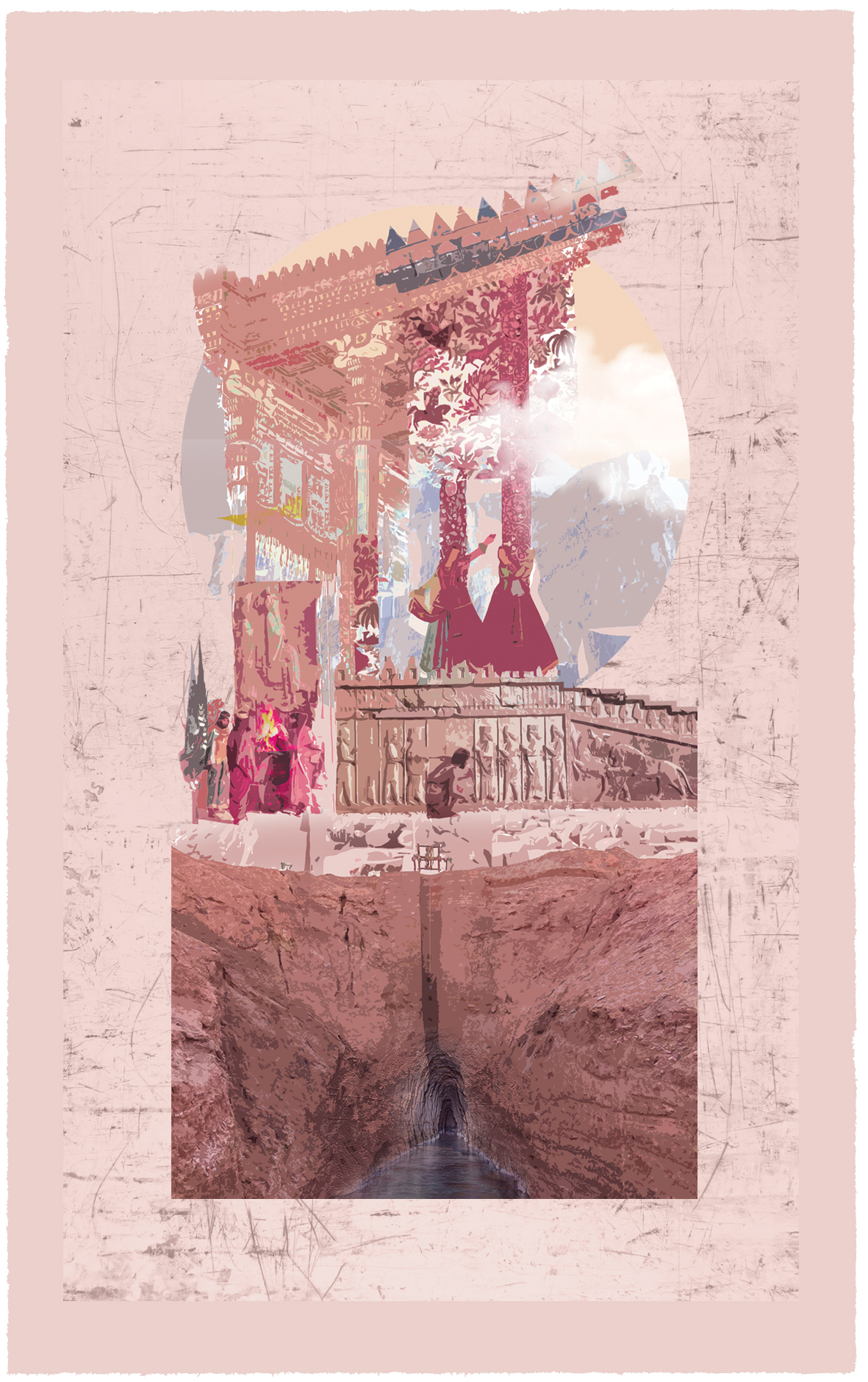
The books stacked in the corner of my room are glossy paper maps to a lost world of underground canals, richly layered gardens, tombs pressed into mountains, grand terraced palaces, and sacred fires – today a pile of ruin. Scouring the pages, I am borne across the ocean with a shovel, to unearth the living layers of antiquity, all in a quest to illuminate my knowledge of who I am and what I am a part of – a quest for my roots.
---
I am lowered down a well; a single frayed rope cinches my waist. Freshly bored earth envelops me on all sides, sliding between my fingers. The air is dense in the qanat (tunnel). The flame of my tallow burner flickers as I descend into the gallery. Clothed in oiled calf leather, I wade through the horizontal gallery (about 120cm high and 80cm wide), crouched 30 metres below the Earth’s surface. The sound of the world above ceases and only echoing waters permeate these underground vessels. Pickaxe in hand, I pry open the earth’s walls, lengthening the qanat until the hidden mountain waters reach my village.
At home, the water flows into the basement, a cool breeze. Coursing through the veins of the desert, it is the lifeblood of my people, the cornerstone of our civilisation. Here in the arid lands, water is scarce; the Zagros and Elbruz mountain chain prevents rain clouds passing into the region. The steady flow turns a motor, spinning two stone slabs, grinding wheat grains into flour.
Further downstream, past my village, lies a pairi-daeza (an enclosed paradise garden), an oasis in the parched sands. A carpet of wild flowers grows amid the fountains. Cultivated from barren land, it is a symbol of the king’s ability to bring symmetry and order out of the disorderly landscape – a reflection of his kingdom. Manifold and moving, the garden is a city within itself; a hunting preserve, a pleasure garden, the local bazaar, the king’s seasonal residence. It is a container of culture. I go to the garden’s bazaar to buy saffron, dates, rice and pomegranates.
In the distance I see the Naqsh-e-Rostam, a rocky mountain face with four punctures. These are the tombs of our Shahs, raised high above the sacred Zamin, so as not to contaminate it. You see, the Earth is our mother. Against the aggressive desert winds, she is piled high on all four sides, sheltering life within – her body, her womb, an enclosure nourishing a paradise, a garden. Moulded by the hands of her children, she is turned to clay. Worn by the winds, she seeps back into the earth from whence she came.
Back home after the day’s events, I tend to the hearth fire. It lives on for as long as the man of the house is alive. The atar is vitality, warmth, protection and transformation. It is sacred, a symbol of divine presence in our homes. I feel the heat sink into my skin. Outside, the chahar taqi, with its four arches and dome, houses another fire. Here, in the presence of nature and under the watchful eye of the sky, we pray.
---