In concluding his 2005 essay Into the Post-War World, the late architect Bill Toomath observed: “In my post-war period a main focus was on community buildings and modestly economical family houses. Yet, in the past decade, five of the nine ‘Home of the Year’ awards made by a national home-maker’s magazine went to lavish holiday houses for the well-to-do.”
In concluding his 2005 essay Into the Post-War World, the late architect Bill Toomath observed: “In my post-war period a main focus was on community buildings and modestly economical family houses. Yet, in the past decade, five of the nine ‘Home of the Year’ awards made by a national home-maker’s magazine went to lavish holiday houses for the well-to-do.”
Every second Friday my daughter goes to the Island Bay Community Centre to attend a group for young adults with intellectual disabilities. My experiences of the building range from drop-offs and pick-ups, to attending birthday celebrations, farewells and Christmas functions.
Like many such centres, this building is an important asset to the people of Island Bay and nearby suburbs, and is popular because it offers spaces for an eclectic variety of groups and activities. These include religious and cultural groups, a book club, a Narcotics Anonymous group, yoga, Pilates, Tai Chi, and a range of dance groups – all reflecting the diverse demographics of the community. These are supported by committed volunteers and part-time paid staff.
The centre interests me because occasionally I give some thought to imagining what it could be like if it received the same level of ‘investment’ as some of the infrequently occupied holiday houses we see winning awards and gracing the pages
of architectural magazines.
The centre is tucked down a driveway between some shops on the main street of Island Bay. The only indication that it’s there is a modest sign fixed to the side of a neighbouring takeaway shop. The asphalt is in poor condition and, because there is no lighting, some kerbing to an adjacent property is a trip hazard that occasionally damages visitors’ vehicles. While there is a separate pedestrian entry nearby, this main entry, with parking for five cars including an accessible park, has no clear delineation for pedestrians.
Despite these shortcomings, the centre is very popular.
Following the demolition of two earthquake-prone shops, the new Community Centre has a highly visible location on The Parade. As well as convenient street parking and a bus-stop outside, there is access to a well-lit landscaped car park behind.
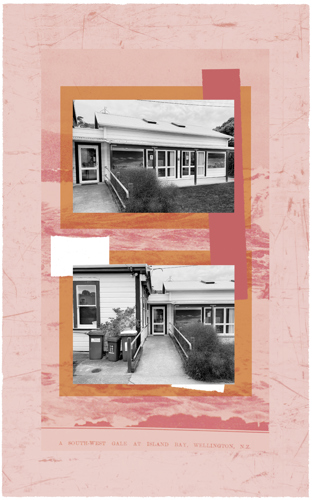
From the car park you can now see the Community Centre. Yellow painted lines on the asphalt and a gap in some bushes signal the way into the property. The building is an early 20th-century villa, to which a simple gable-roofed hall has been added. There is a concrete path that bisects a lawn. Sitting in the middle of one section of lawn is a sadly weathered timber picnic table, and some stone carvings have been randomly placed. There are several doors opening off the hall and the villa so it is not immediately apparent where the main entry is.
Continuing on the path, you come to a point where two accessible ramps meet. One is no longer in use, evidenced by rubbish bins parked at its base. The other leads to what appears to be the entry – a single outward-swinging door. The ramp handrails are unpainted galvanised steel and the width is little more than Building Code minimum – it is often unpleasantly congested in this area at drop-off and pick-up times.
Despite these shortcomings, the centre is very popular.
The double-height scale of the centre sits well with its neighbours, and the landscaped setback suggests that this is a special building – giving something back to the street. There are small details that say something about the community including a carved pou, a weathervane in the shape of a fishing boat, and a generous number of bike parks. The ideas and design of these were informed by a participatory design process. Set between two areas of native planting is a wide section of gently sloping stone paving leading to the double entry doors, sheltered by a broad canopy. There is some built-in hardwood seating where people can wait under cover, with a view of the street.
Once inside, there is a small lobby space dominated by a Civil Defence cupboard and a table with lots of pamphlets laid out. This area gets very congested and is unpleasantly hot in the warmer months. Turn right and you’ll go into the hall space with a kitchen attached; turn left and there is a narrow corridor. The hall is a basic space with steel portal frames, and some suspended industrial lights and radiant heaters. There are glazed doors on the west side but these are seldom used because there is quite a step down to a sheltered concrete area outside – perhaps they are opened for more able-bodied groups. A resilient yellow-coloured vinyl lines the walls up to door height.
To add to the institutional aesthetic, all the projecting corners are finished in an aluminium trim for protection. The wall above this and the ceiling are painted plasterboard. The hall’s functional plainness is redeemed by its natural timber floor, although the spongy feel underfoot suggests that this is actually a thin veneer. There is a sound system mounted on a corner shelf and a miscellany of posters nearby. The hard finishes everywhere make the space very reverberant and the acoustics unpleasant for some.
Despite these shortcomings, the centre is very popular.